Planning a New Fence and Getting a Free Estimate
If you have requested fence quotes in more than one city in western Washington, you have noticed the numbers do not match. Average fence installation costs vary by city, material, and site complexity in Washington. Fence installation cost in Washington varies more than most homeowners expect, and the gap between Olympia, Bellevue, and Mercer Island proves it. The same 150 linear feet of cedar privacy fence can produce very different quotes depending on where you are building. That is not random. It is driven by terrain, labor markets, local code, HOA requirements, and site access.
A company like Cool Cat Fence works across all three markets and sees these differences on every project. The cost factors shaping your quote have little to do with luck and everything to do with conditions on the ground. Understanding why a fencing project in Thurston County costs less than the same wood fence in King County is the first step toward reading a quote with confidence.
This article breaks down the real cost drivers so your next estimate makes sense before you sign. You will learn how terrain shapes installation complexity, why permits vary based on location, how labor rates differ across the Seattle area, what HOA rules mean for your material choices, and how logistics affect the final price on every yard in the Pacific Northwest.
Fence Cost: Olympia vs. Bellevue vs. Mercer Island – Comparison Table | |||
Factor | Olympia | Bellevue | Mercer Island |
JURISDICTION | |||
County | Thurston | King | King |
Key Code Reference | OMC 18.40 | LUC 20.20.400 | MICC 17.14.010 |
FENCE HEIGHT RULES | |||
Front Yard Max Height | 42 in (3.5 ft) | 4 ft 6 in (54 in) | 4 ft (typical residential) |
Side/Rear Max (no permit) | 6 ft | 8 ft | 6 ft |
Permit Trigger | Required for all fences; homeowner applies | Only over 8 ft | Only over 6 ft |
Sight-Obstruction Rules | Yes, corner lots | Yes, per BCC 14.60.240/241 | Yes, intersection visibility |
Design Review Districts | Yes, some neighborhoods | No formal historic districts | No formal historic districts |
TERRAIN & SITE CONDITIONS | |||
Typical Terrain | Mostly flat to gentle slope | Hilly, wooded, varied by neighborhood | Sloped, wooded, waterfront lots common |
Soil Conditions | Workable; clay-heavy in spots | Rocky patches, root systems (Bridle Trails, Somerset) | Root-heavy, mature landscaping, variable |
Site Access | Generally straightforward | Narrow lots in older neighborhoods | Limited side yards; equipment delivery constrained |
Waterfront Considerations | Rare for residential fencing | Some properties near Lake Washington | Common; shoreline management regulations apply |
Critical Areas Overlay | Some environmental review | Yes, wetlands/streams restrict placement | Yes, wetlands/steep slopes/shoreline add restrictions |
HOA & COMMUNITY STANDARDS | |||
HOA Presence | Light; many neighborhoods have none | Heavy; many active HOAs with architectural review | Mixed; fewer formal HOAs but strong neighborhood norms |
HOA Impact on Fence | Minimal in established areas | Can restrict material, color, height, style | De facto standards on materials and finish quality |
LABOR & LOGISTICS | |||
Labor Market | Less competitive; Thurston County rates | High demand; King County rates | King County rates + island logistics premium |
Material Delivery | Simple; direct highway access | Standard metro delivery | All materials arrive via I-90; limited access points |
Disposal/Hauling | Standard | Standard | Off-island hauling adds cost |
OVERALL | |||
Relative Cost Position | Most competitive of the three | Mid to high range | Highest range |
Olympia – Flatter Land, Simpler Builds, and Flexible Fencing Materials

Fence cost in Olympia tends to sit at the more affordable end of the spectrum for western Washington, and the reasons are straightforward. The city’s position in Thurston County puts it outside the steep lakeside terrain that defines the Eastside. Most residential lots in neighborhoods like Westside, Governor Stevens, and the areas around Boulevard Road are relatively flat or gently sloped, which translates directly into simpler fence installation and fewer surprises during site preparation.
Soil conditions across Olympia are generally workable, though some areas are clay-heavy. That clay can slow post-hole digging in wet months, but it does not present the rock and root challenges that increase labor costs in King County. Local fence contractors working these lots can typically complete standard straight-run installations without specialized equipment or stepped designs.
Olympia requires building permits for fences. https://www.olympiawa.gov/services/building_permits___land_use_review/index.php Homeowners handle the application process, with front-yard fences capped at 42 inches in residential zones and side and rear fences allowed up to 6 feet. Properties in Design Review Districts may need additional city approval, but the overall process remains predictable and less layered than what you encounter in Bellevue or on Mercer Island.
HOA presence is lighter here than on the Eastside. Some newer developments have covenants governing fence style and materials, but many established Olympia neighborhoods have no HOA at all. Fewer approval steps mean fewer delays. Fewer material restrictions mean homeowners can choose cost-effective options without community pushback. Even a standard privacy fence cost stays relatively contained because the conditions cooperate.
The labor market in Thurston County is less pressured than King County. Contractor demand is lower, material delivery routes are simpler, and scheduling tends to be more flexible. Lower overhead feeds directly into the quote. Olympia generally produces the most competitive fence quotes of the three cities. Not because the work is lower quality. Because the conditions are simpler. In Olympia, WA, typical project costs range from roughly $3,000–$4,100.
Bellevue – Terrain, HOAs, and Labor Costs in a Competitive Market

Fence cost in Bellevue climbs higher than Olympia for reasons that become obvious once you understand the terrain. Installing a fence in the Seattle-Eastside area (Bellevue/Mercer Island) costs $80–$110 per foot for cedar. The city stretches from Lake Washington to Lake Sammamish, covering neighborhoods with dramatically different lot conditions. Somerset sits on hillsides with significant grade changes. Bridle Trails lots are wooded with root systems that complicate post-hole digging and require additional labor. Vuecrest has 12,000-square-foot lots with slope and view considerations that demand custom designs. Lake Hills, originally built on flat former farmland, has pockets of uneven terrain near its greenbelt corridors. https://dahp.wa.gov/sites/default/files/Mid-CenturyKingCounty_ResidentialContextStatement_2017.pdf
That topography directly affects the total project cost. Stepped fencing on a slope requires more posts, more materials, and more labor than a straight run on level ground. Steep slopes mean each section must be individually measured and cut. Root removal, rocky soil, and limited equipment access on narrow lots all add time and expense. Professional installation on challenging Bellevue lots often requires hand-digging when equipment cannot reach the work zone.
Bellevue fence rules fall under Land Use Code 20.20.400. https://bellevue.municipal.codes/LUC/20.20.400 In Bellevue, a permit generally isn’t required unless a fence exceeds 8 feet, while front-yard placement is often limited for fences over 4½ feet. Corner lots must comply with the city’s sight-obstruction rules (BCC 14.60.240 and BCC 14.60.241). The fence permit cost in Bellevue itself is minimal for standard residential builds under 8 feet. The real expense is the time and documentation that HOA review adds to the timeline. https://bellevuewa.gov/city-government/departments/development/zoning-and-land-use/zoning-requirements/fences
Many Bellevue neighborhoods have active HOAs or community associations that regulate fencing materials, colors, heights, and styles. Some require architectural review before installation begins, pushing homeowners toward higher-quality materials like cedar or vinyl fence options that meet community standards. This adds weeks to the timeline and can influence cost substantially.
Fence contractor labor rates in the Seattle area are driven by demand. In wealthy ‘Eastside’ zip codes like Bellevue and Mercer Island, labor rates are often 10–20% higher than in the South Sound (Olympia). King County has more projects competing for the same crews, and that pressure shows up in every quote. A Bellevue fence company working these lots builds terrain challenges and HOA complexity into their detailed estimates because they know what the work actually requires.
Mercer Island – The Premium Tier, and Why

Fence cost on Mercer Island sits at the top of the range for the region, and the reasons are structural rather than arbitrary. The city occupies roughly 6 square miles surrounded by Lake Washington, and every material, tool, and crew member arrives via one of two access points off I-90. That logistical reality affects every construction project on the island, fencing included. Travel time for crews is longer. Delivery windows are tighter. Debris haul-off involves hauling everything back off-island.
Lot conditions compound the challenge. Properties on Mercer Island tend to be large, often sloped, and heavily landscaped with mature trees. Waterfront homes come with shoreline management regulations, steep grades, and access constraints that can make equipment delivery difficult. Even non-waterfront properties sit on wooded lots where root systems, existing landscaping, and narrow side yards complicate installation. A taller fence on one of these properties may require additional features like post caps and decorative elements to meet the island’s aesthetic expectations.
On Mercer Island, fences not over 6 feet are generally exempt from building permits under the city’s permit guidance. https://www.mercerisland.gov/cpd/page/building-permits-when-are-they-required Anything over 6 feet requires approval. Properties in critical areas such as wetlands, steep slopes, or shoreline zones face additional restrictions regardless of fence height. Homeowners should confirm local regulations with the city before starting any fencing project.
Formal HOA fence rules on Mercer Island are less common than in Bellevue, but the de facto standard is just as strict. Neighborhood expectations on materials, finish quality, and installation precision function as an unwritten code that shapes what contractors quote and what homeowners accept. The associated costs of meeting these standards show up whether or not they are itemized.
Working with Mercer Island fence experts who understand these conditions is essential. They know the access challenges, the community expectations, and the permitting nuances. Everything tends to cost more to deliver and execute on the island. That is simply the reality of building here.
Fence Style and Fence Height: Cost Factors That Matter Everywhere
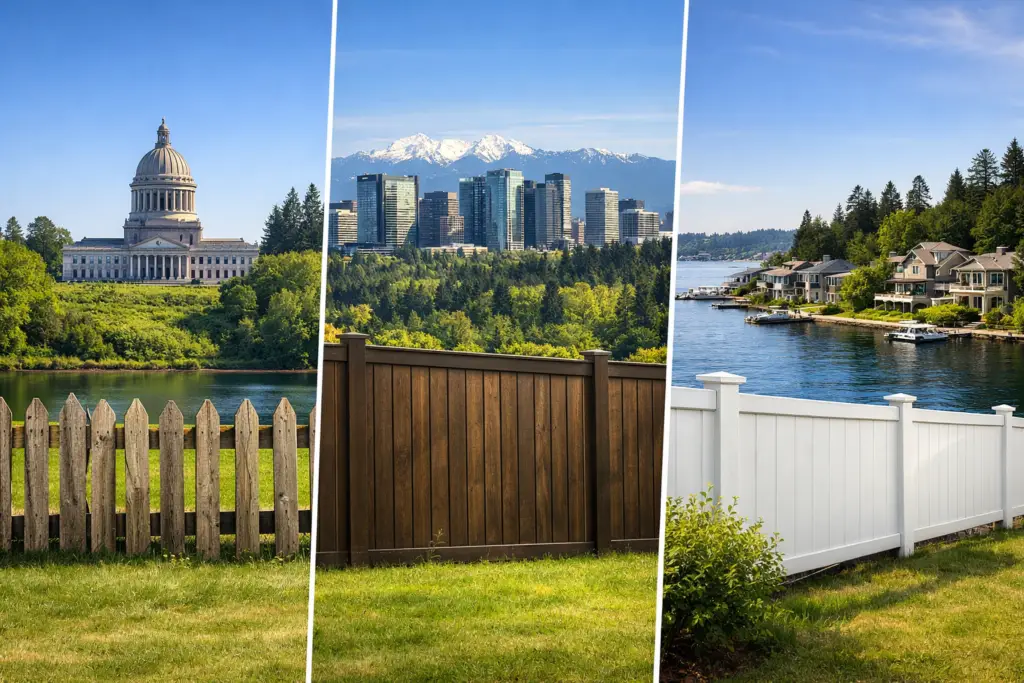
Regardless of which city you are building in, several factors influence cost across the board. Wood fence cost per linear foot depends on species and grade. Cedar outperforms pressure-treated pine in the Pacific Northwest climate because it resists rot and requires fewer repairs over time, but it carries a higher starting point. For many homes, a cedar wood fence is the default for warmth and longevity. The long term value often justifies the upfront premium for homeowners planning to stay in their property.
Vinyl fence cost per foot runs higher initially than wood, though the lifetime math changes when you factor in low maintenance, no staining, and no board replacement. Vinyl fence installation makes sense for homeowners who want minimal upkeep and long term savings. Chain link fence cost per foot is the lowest entry point, but it rarely fits the visual character of established residential neighborhoods in Olympia, Bellevue, or Mercer Island. Metal fences like aluminum fences or wrought iron fence options carry their own price profiles, with wrought iron sitting at the premium end of material costs.
Fence height and style also influence cost. A 6-foot privacy fence uses more materials and labor than a 4-foot picket. Horizontal board designs cost more than standard vertical because of cutting and spacing requirements. Custom designs with decorative elements add to the overall cost.
Fence replacement cost catches many homeowners off guard. Removing and disposing of an old fence adds to the project total, and full replacement is not always included in a base quote. Ask whether removal and haul-off are billed separately. Gates add hardware, framing, and fitting time. Double gates and custom widths cost more than standard walk-throughs.
Property lines matter in older neighborhoods across all three cities. https://app.leg.wa.gov/rcw/default.aspx?cite=16.60 Boundary discrepancies exist, and a survey before building prevents disputes and potential tear-downs. Taking time to confirm property lines before fence posts go in is always worth the investment.
Conclusion and Next Steps: Get a Free Estimate With the Right Scope
The fence cost factors that separate Olympia from Bellevue from Mercer Island are not mysterious. They are terrain, code, access, labor, and expectation. Understanding them is the difference between reading a quote and actually understanding it. Average cost comparisons and national figures mean little when your yard has steep slopes, your HOA requires specific fencing materials, or your property sits on an island with limited access.
The smartest thing a homeowner can do is know what drives the number before comparing bids. Get a site assessment. Understand what your quote includes and what falls outside the base price. Ask about site preparation, permit handling, and debris removal. Request multiple quotes and compare the scope of work, not just the bottom line.
The best contractor is the one who can explain every line on the page clearly. They will give you an accurate estimate based on your actual conditions, not a generic number pulled from somewhere else. That is how you get a budget that holds and a new fence that stands.
FAQ: Fence Leaning Problems and Fix Options
Why does the same fence cost more in Bellevue than in Olympia?
Bellevue’s higher labor rates, hilly terrain, HOA approval requirements, and King County logistics all contribute to higher fence quotes compared to Olympia. Thurston County generally has simpler site conditions, fewer HOA restrictions, and a less competitive contractor market, which keeps project costs lower for comparable work.
Do I need a permit to build a fence on Mercer Island?
Fences up to 6 feet tall on Mercer Island are generally exempt from building permits per city code. Fences over 6 feet require a permit. Properties in critical areas such as wetlands, steep slopes, or shoreline zones may face additional restrictions regardless of fence height. Confirm requirements with the City of Mercer Island before starting.
Does terrain affect fence installation cost?
Yes, significantly. Sloped lots require stepped or racked fencing, additional posts, custom cuts, and more labor time. Rocky or root-heavy soil slows post-hole digging. Properties with limited equipment access, common on Mercer Island and in some Bellevue neighborhoods, may require hand-digging, which increases labor costs substantially.
Do HOA rules affect fence cost in Bellevue?
They can. Many Bellevue HOAs restrict fence materials, colors, heights, and styles. Some require architectural review before installation begins. Meeting these standards often pushes homeowners toward higher-quality materials and professional installation, which affects the total cost compared to neighborhoods without community oversight.